By Rowan Obach, C2ST Intern, Loyola University
Jonathan Pereira is the executive director of Plant Chicago, a nonprofit helping to cultivate local circular economies. The organization connects people from all across the food chain to help reduce waste and make sure as much of our waste is being reused as possible. Jonathan obtained a BS in Geology and an MEd in Science Education. He continues to work with local businesses to try and get as many individuals involved and educated about circular economies. I was able to learn more about him and his role in the following interview. Continue reading “Going Full “Circle” with Jonathan Pereira”
By Laura Tran, C2ST Intern, Rush University
For centuries, humans have always been fascinated with flight. We dream about it. We read about it in science fiction. We either watch it in film or we observe it in popular culture. Let’s face it, we have wing envy!
According to Yale Scientific¹, it is mathematically impossible for humans to fly like birds. In the equation for flight, there are four components: 1) lift (the upwards acting force), 2) gravity (the downwards force), 3) thrust (the forward acting force), and 4) drag (the backward acting force). A bird can fly because it is lightweight and has strong wing muscles, providing them with the appropriate aerodynamic capability. Simply put, birds can overcome gravity and take flight. Continue reading “The Pursuit of Flight”
By Rowan Obach, C2ST Intern, Loyola University
As the US continues to offer vaccinations across the country, many people remain skeptical. But why? According to the American Psychiatric Association, many individuals want to get the vaccine but are bombarded by misinformation and complicated science articles. This is being combatted by the VACCINES Act; a federally funded national messaging campaign to improve vaccination rates. Vaccines are a complicated mechanism, but by breaking them down and explaining them, we can all help remove the fear from COVID vaccinations. Continue reading “COVID Vaccines: The How, What, & Why of Production”
By Elizabeth Hallissey, C2ST Intern, Loyola University
Many people see lightning as scary and threatening, but recent data may improve lightning’s reputation.
Lightning strikes produce nitric oxide, which leads to the formation of other oxidants, all of which have the potential to increase the atmosphere’s ability to cleanse itself. While researchers originally thought that the oxidant production effects of lightning strikes were not significant enough to bring about meaningful atmosphere cleansing power, a recent analysis of a 2012 study has revealed that the opposite may be true. As we contend with the worsening effects of pollution on our atmosphere and other parts of the environment, a reversal in thinking like this brings with it a newfound sense of optimism in the scientific community.
Continue reading “Lightning Strikes: Nature’s Air Purifier?”
By C2ST Staff
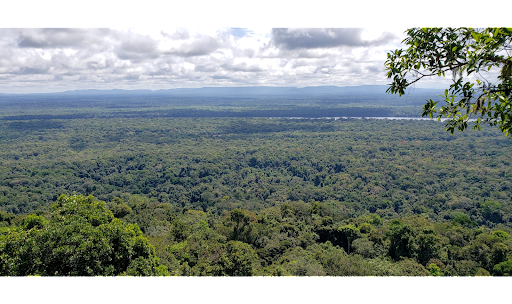
Guyana is a country that is mostly rainforest–87%, to be exact. It is bordered by Venezuela to the west, Suriname to the east, Brazil to the south, and the Atlantic Ocean to the north. Those countries all comprise part of the Guiana Shield, which houses one of the world’s last major frontier forests. Frontier forests are intact, uncompromised swaths of land that are large enough to withstand natural disasters, and healthy enough to support all of the animals and plants that reside there. These characteristics make the forest, and the country as a whole, a biodiversity hotspot worthy of international recognition and protection. Continue reading “Guyana Pt. 1: Unspoiled Rainforest”