By Alex Zhang, C2ST Intern, DePaul University
Just a few weeks ago I was fishing at Ottertail Lake, Minnesota, searching for Northern Pike. Like many fishermen, mobile apps and online threads help me gauge which species are located in each freshwater body. Through the collective knowledge of previous successful fishermen in an area, the internet allows us to gain a rough understanding of what we could find. For casual hobbyists, anecdotal evidence is more than enough to set up the right fishing strategy. But for scientists studying freshwater systems, obtaining precise results requires sampling fish on a much larger scale than the catch-and-click process. So how do they accomplish this?
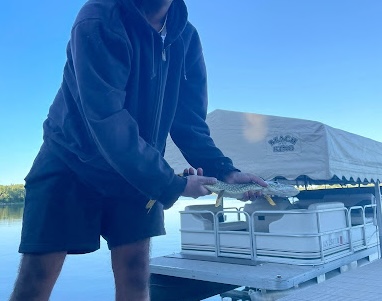
(My brother holding a tiny pike we caught in Ottertail Lake.) Picture #1
In many shallow freshwater bodies, electrofishing is the preferred method for rapid research of fish populations, allowing scientists to collect dozens of individuals at once. While it may sound like a “shocking” technique, electrofishing is in fact a minimally invasive and reliable system used since the mid 1800s! The practice of stunning fish itself has existed within indigenous cultures for centuries with plant toxins; electrofishing simply presents a relatively new method of stupefying. The basic electrofishing boat outfit includes a metal boat, a generator, and a number of poles hanging from the front of the boat (referred to as booms or anodes). Once the boat is in the desired sampling area – and hopefully floating above a number of fish – the poles are lowered underwater.
Using a foot pedal to control the electricity, a circuit is created using the poles as a ‘positive’ end and the metal boat itself as a ‘negative’ end. Electric currents are pulsed through the booms, traveling the circuit and directly through the water, causing a process called galvanotaxis in nearby fish. Galvanotaxis appears just like “The Force” from Star Wars or Professor X’s telekinesis from Marvel’s X-Men; affected fish are forced to swim towards the boat against their will. But what seems like mind control is actually the biological process of involuntary muscle movement, caused by interactions between an electric current and the body of a fish. You can think of this similarly to the “It’s Alive!” scene in any Frankenstein media, where the creature jolts to life after it’s shocked with high-intensity voltage. The comparison is useful for understanding involuntary muscle movement, but electrofishing’s effects are far less violent than this.
While risks are always present, galvanotaxis is generally not harmful to fish assuming proper care, equipment, and methods are followed. The practice has been continually refined since its origins nearly 200 years ago, and modern electrofishing is an effective and efficient way to sample many aquatic species (even including crustaceans!). Once the stunned fish swim towards the boat, scientists use a net to scoop them up. From there, they can identify the species of fish, measure their physical traits, and administer a variety of other tests to learn more about the marine ecosystem. The fish are then placed back in the water unharmed and unchanged.
Of course, electrofishing cannot be used in every scenario. Some freshwater bodies can be too deep for the electric current to work on fish, while the salt in non-freshwater bodies disrupts electrical currents and requires a different approach. The size and weight of a fish also change its effectiveness. Yet overall, electrofishing is an extremely useful tactic to be aware of, and represents one of the many ways ancient practices have evolved through modern technology. Now if only I could actually mind control the fish to swim to my bait! (Be warned, electrofishing is permitted for science purposes only and is illegal for fishermen.)
Sources:
Electrofishing – an overview | ScienceDirect Topics, accessed July 1, 2026.
Electrofishing – FISHBIO | Fisheries Consultants.
Alonso (2001).
Fish Monitoring via Electrofisher – DNREC, accessed July 2, 2026.
Florida Fish and Wildlife Commission, accessed July 3rd, 2026.
IISD Experimental Lakes Area, accessed July 2, 2026.
James Reynolds, American Fisheries Society (2020).
Robert Heizer, Smithsonian Institution (1953).
Understanding Electrofishing: A Vital Tool for Fish Population Management (2025).
Washington Department of Natural Resources (2016).